Recent news and science highlights from e-MERLIN, MERLIN and VLBI
New images from a super-telescope bring astronomers a step closer to understanding dark matter
16th June 2018
EMBARGOED UNTIL JUNE 16, 2018 AT 01:00 UTC
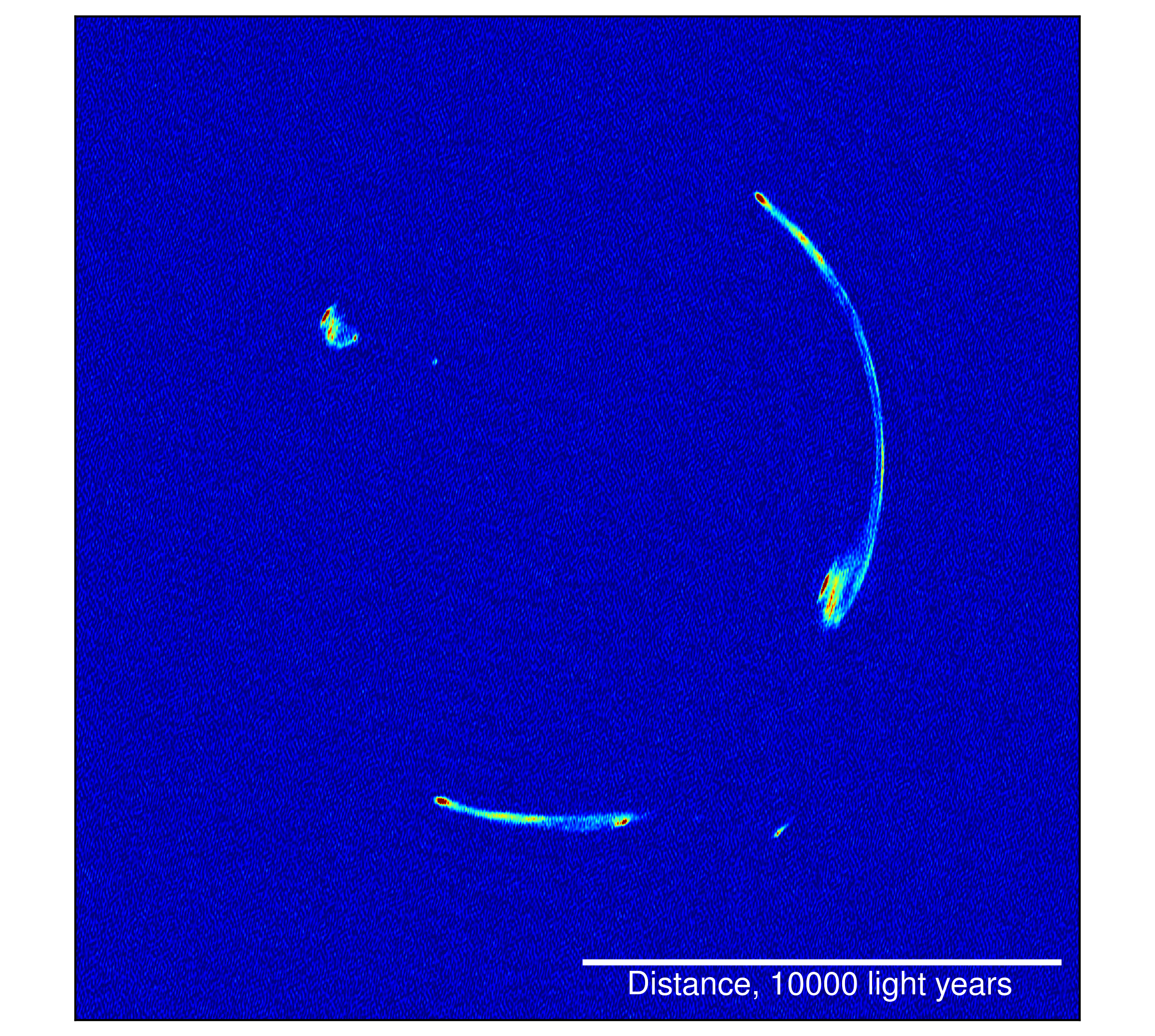
Astronomers using a global network of radio telescopes, including the 76-m Lovell telescope at Jodrell Bank Observatory, have produced one of the sharpest astronomical images ever. The resulting image demonstrates that dark matter is distributed unevenly across a distant galaxy.
The image was created by combining data from a global radio telescope network, comprised of the European VLBI Network, and the Very Long Baseline Array and Green Bank Telescope in the United States, in an effort to address some of the fundamental questions about dark matter. The international team of astronomers aim to determine how much dark matter is present in galaxies and how it is distributed. According to current theories, a galaxy, such as our Milky Way, should have thousands of dwarf galaxies orbiting around it, yet to date only approximately 100 have been found.
"It has been suggested that these dwarf galaxies could be dark matter dominated and, therefore, highly difficult to observe. However, throughout the distant Universe, we can discover the presence of these small mass structures only by using the gravitational lensing effect," explains Cristiana Spingola, lead author on the paper, from The Netherlands Institute for Radio Astronomy (ASTRON) and the Kapteyn Astronomical Institute.
Gravitational lensing allows astronomers to observe incredibly distant radio sources that cannot be directly detected. By observing how the radio emission from the distant source is bent by the gravitational field of a massive object - the lens - located between the source and the Earth, it is possible to determine information about both the distant source and the lens. In this study the researchers used the radio source MG J0751+2716, at such great a distance that it has taken the light 11.7 billion years to reach the Earth. This object is comprised of a black hole with a powerful ejection of material, known as a jet. The lens consists of a group of galaxies located at a look-back time of 3.9 billion years from Earth.
In the study, the astronomers were able to determine the distance, brightness and projected size of the radio source, together with the composition of dark matter across the lens, which appeared clumpy and uneven.
"For the first time we were able to observe large gravitationally lensed arcs on extremely small angular scales. The background source - the black hole with radio jets - is distorted into these arcs on the image because of the gravitational effect of the foreground galaxies (the lens). It is a rare possibility to get such an extended arc." Spingola added, "the unprecedented detail of these extended gravitational arcs allowed us to infer with high precision the distribution of the matter of the galaxy acting as a lens."
It is only possible to obtain such high-resolution data by coordinating multiple telescopes to observe the same radio source simultaneously. In this case, 24 radio antennas from across the globe were connected using a technique called Very Long Baseline Interferometry (VLBI). Data from all the telescopes was collated in a process known as correlation, at a super computer housed at the Joint Institute for VLBI ERIC in Dwingeloo, the Netherlands.
To better understand the properties for dark matter, the team are now applying sophisticated numerical algorithms to quantify the nature of the clumpy dark matter. But, they are also on the hunt for more extended gravitational arcs just like this.
"There are only a limited number of gravitational lenses suitable for this study, and while we have started this search using the European VLBI Network and the Very Long Baseline Array we expect that there will be more giant radio arcs in the future," explained John McKean, project lead from the Netherlands Institute for Radio Astronomy (ASTRON) and the Kapteyn Astronomical Institute.
This study was led by John McKean from the Kapteyn Astronomical Institute, University of Groningen and the Netherlands Institute for Radio Astronomy (ASTRON), Dwingeloo on behalf of the international research team SHARP (Strong Lensing at High Angular Resolution Project) led by Chris Fassnacht (University of California, Davis), and also including Matt Auger (University of Cambridge), Leon Koopmans (University of Groningen), David Lagattuta (University of Lyon) and Simona Vegetti (Max Planck Institute for Astrophysics). Their findings can be found in Issue 4, Volume 478 of the Monthly Notices of the Royal Astronomical Society, published by Oxford University Press.
Additional Information
The European VLBI Network (EVN) is a network of radio telescopes located primarily in Europe and Asia, with additional antennas in South Africa and Puerto Rico, which performs very high angular resolution observations of cosmic radio sources.
Collectively the EVN forms the most sensitive radio telescope array at both centimetre wavelengths and milliarcsecond resolution. The data collected at each of the individual stations is collated centrally at the correlator - a data processor housed at the Joint Institute for VLBI ERIC (JIVE) in Dwingeloo, the Netherlands.
The following EVN antennas observed during the experiment: Seshan, Urumqi (China), Effelsberg (Germany), Medicina, Noto (Italy), Westerbork (The Netherlands), Torun (Poland), Badary, Svetloe, Zelenchukskaya (Russia), Robledo (Spain), Onsala (Sweden), and Jodrell Bank (The United Kingdom). The Very Long Baseline Array and the Green Bank Telescope (United States) from NRAO were also part of the experiment to form a global array of telescopes.
Astronomers See Distant Eruption as Black Hole Destroys Star
14th June 2018
EMBARGOED UNTIL TUESDAY, JUNE 14, 2018 AT 14:00 US EDT / 19:00 BST
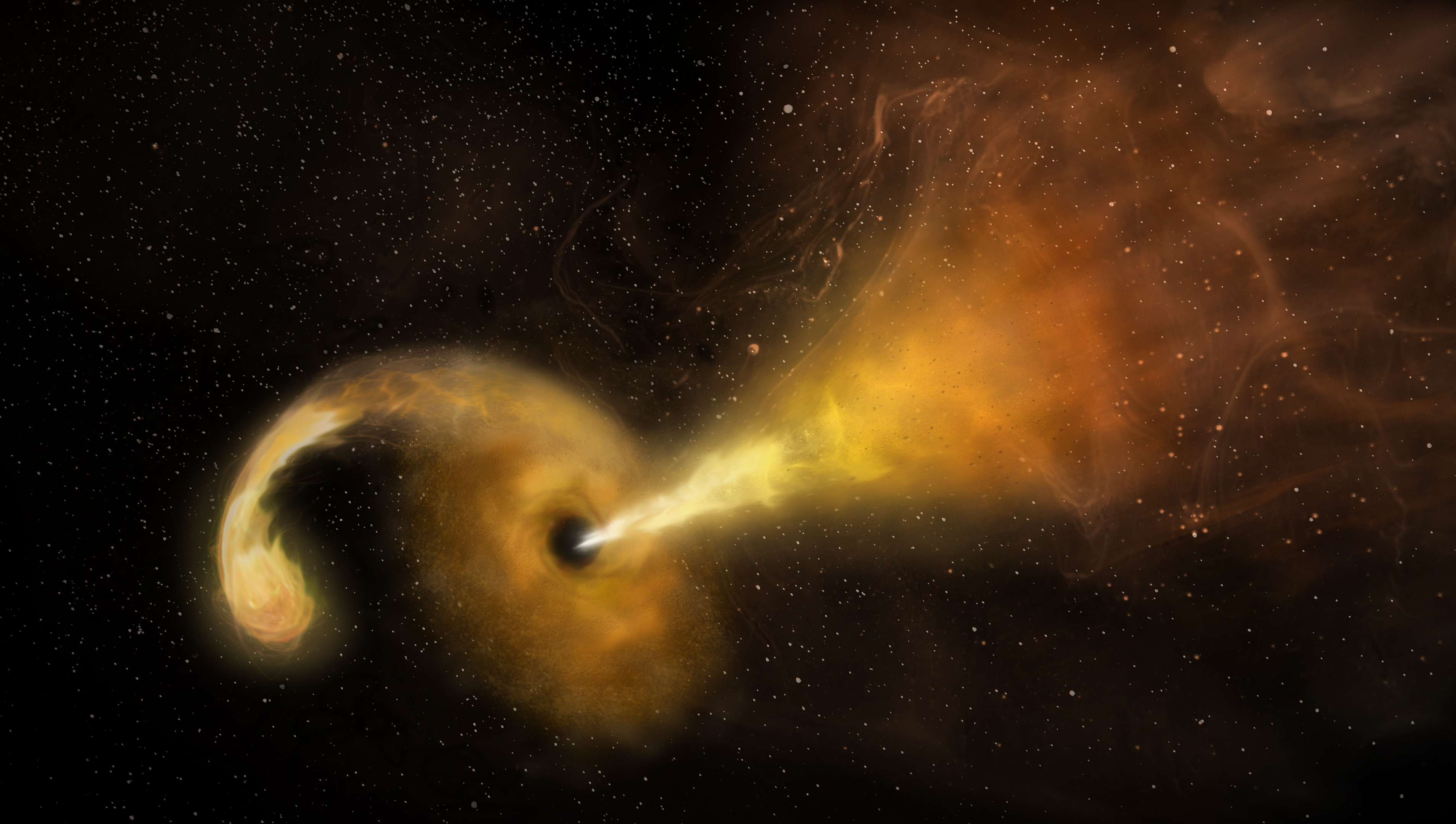
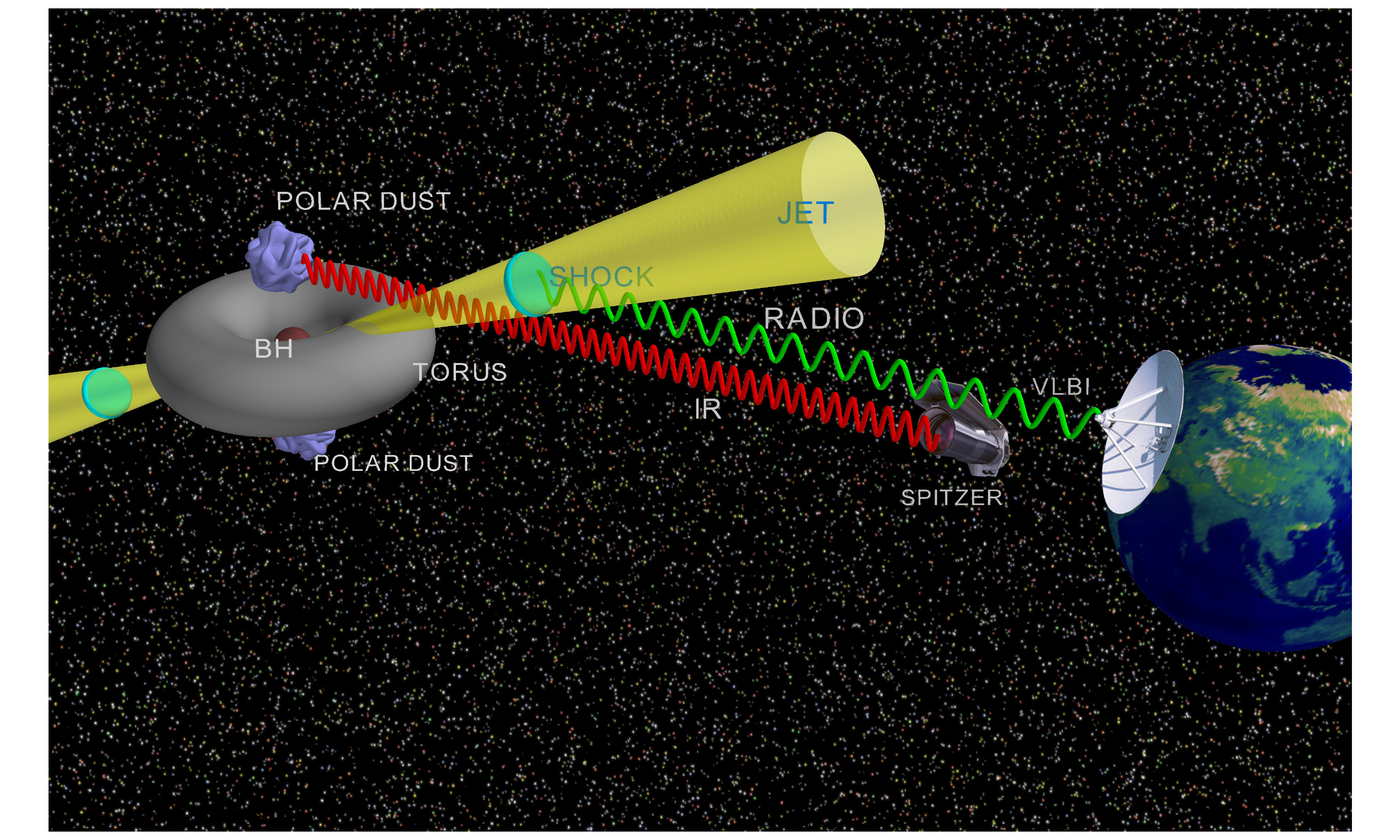
For the first time, astronomers have directly imaged the formation and expansion of a fast-moving jet of material ejected when the powerful gravity of a supermassive black hole ripped apart a star that wandered too close to the massive monster.
The event took place in a pair of colliding galaxies called Arp 299, nearly 150 million light-years from Earth. At the core of one of the galaxies, a black hole 20 million times more massive than the Sun shredded a star more than twice the Sun's mass, setting off a chain of events that revealed important details of the violent encounter.
The scientists tracked the event with multiple radio and infrared telescopes, including the Lovell Telescope at Jodrell Bank Observatory, working as part of the European Very Long Baseline Network (EVN).
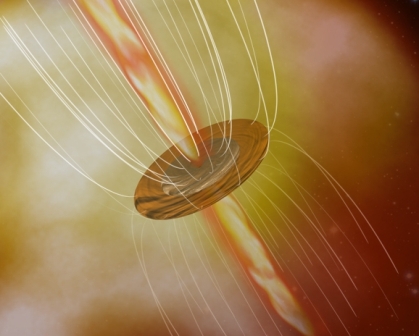
Only a small number of such stellar deaths, called tidal disruption events, or TDEs, have ever been detected. Theorists suggested that material pulled from the doomed star forms a rotating disk around the black hole, emitting intense X-rays and visible light. It also launches jets of material outward from the poles of the disk at nearly the speed of light.
"Never before have we been able to directly observe the formation and evolution of a jet from one of these events," said Miguel Perez-Torres, of the Astrophysical Institute of Andalucia in Granada, Spain. "Tidal disruption events can provide us with a unique opportunity to advance our understanding of the formation and evolution of jets in the vicinities of these powerful objects," he added.
Dr Rob Beswick, from the Jodrell Bank Centre for Astrophysics at The University of Manchester's School of Physics and Astronomy, and co-investigator of this project, said: "This is a fantastic discovery and an extremely important result in astronomy. It is a testament to the persistence of the science team and demonstrates the power of globally coordinated VLBI observations, including multiple telescopes from Jodrell Bank Observatory and the e-MERLIN array in the UK."
Dr Beswick, who is also Head of Science Operations and Support of UK's e-MERLIN/VLBI National Facility, added: "The discovery came as a surprise. The initial infrared burst was discovered as part of a project that sought to detect supernova explosions in such colliding pairs of galaxies. Arp 299 has seen numerous stellar explosions, and has been dubbed a 'supernova factory.' This new object originally was considered to be a supernova explosion."
Tidal disruption Events may have been more common in the distant Universe, so studying them may help scientists understand the environment in which galaxies developed billions of years ago. The discovery of this event embedded in a dust obscured galaxy, and not seen in visible or X-ray light, may mean it is just the tip of the iceberg of an until now hidden population. Seppo Mattila, of the University of Turku in Finland added that "By looking for these events with infrared and radio telescopes, we may be able to discover many more, and learn from them."
The discovery has taken over a decade to unravel. The first indication came on January 30, 2005, when astronomers using the William Herschel Telescope in the Canary Islands discovered a bright burst of infrared emission coming from the nucleus of one of the colliding galaxies in Arp 299. On July 17, 2005, the National Science Foundation's Very Long Baseline Array (VLBA) revealed a new, distinct source of radio emission from the same location.
The researchers then used the Nordic Optical Telescope on the Canary Islands and NASA's Spitzer space telescope to follow the object's infrared emission. Continued observations with the EVN, VLBA and other radio telescopes, carried out over nearly a decade, showed the source of radio emission expanding in one direction at an average of one-quarter the speed of light, just as expected for a jet.
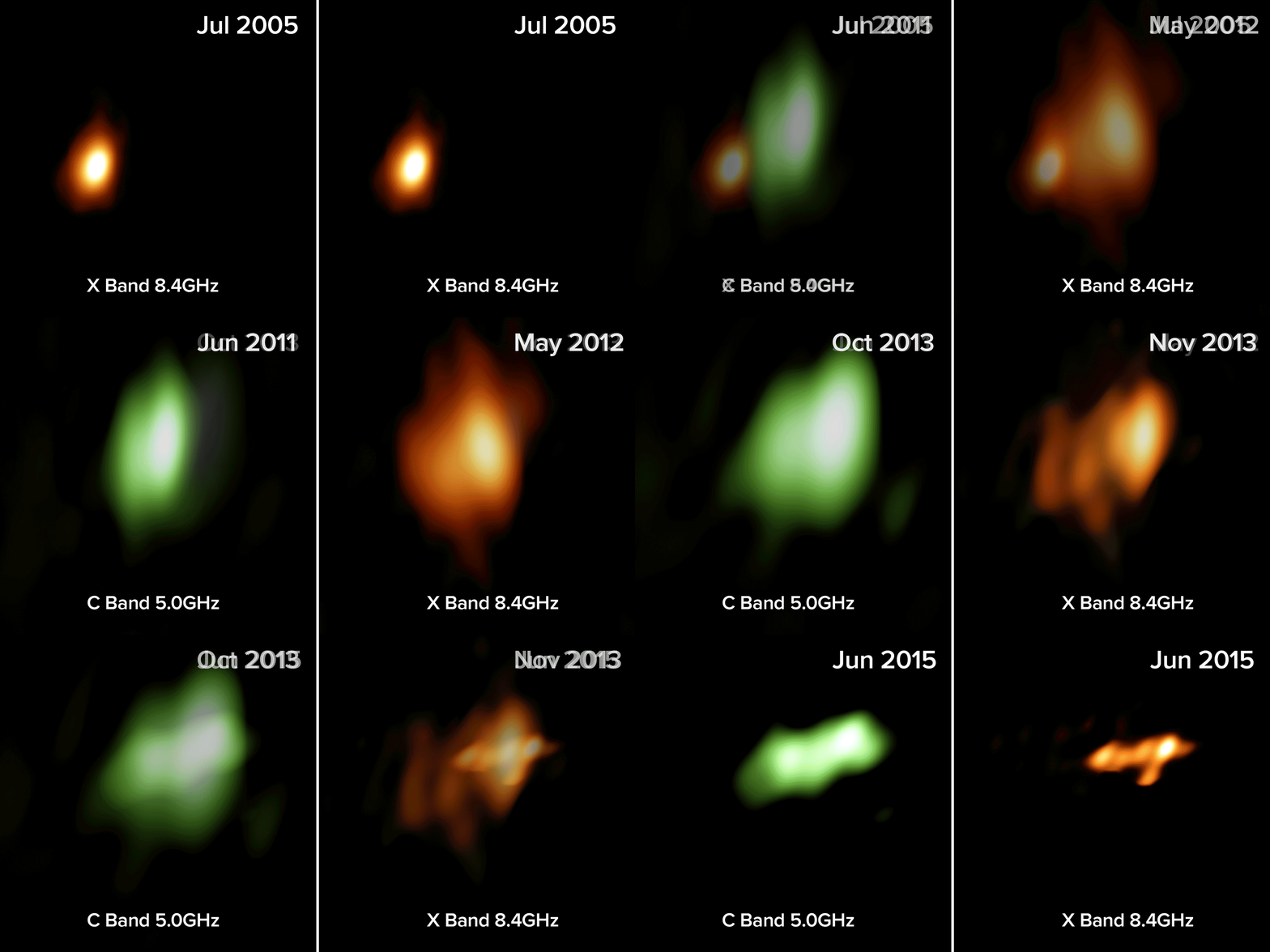
Only in 2011, six years after discovery, the radio-emitting portion began to show an elongation. Subsequent monitoring showed the expansion growing, confirming that what the scientists are seeing is a jet, not a supernova.
These observations used multiple radio-telescope antennas, separated by thousands of miles, to gain the resolving power, or ability to see fine detail, required to detect the expansion of an object so distant. "A global network of collaborating radio antennas is the only way to see this jet structure and study the evolution of such distant objects in detail." says Eskil Varenius, formerly at Onsala Space Observatory in Sweden, now at Jodrell Bank Centre for Astrophysics in the UK. "It is incredible what these telescope networks can do. This is a clear case where international collaboration achieve a combined whole much greater than the sum of its parts."
The finding of this work are published in the journal Science ( Mattila, Perez-Torres et al, 2018, Science.)
(END)Futher Background
Related press releases:
NRAOJIVE NASA/JPL
Additional information:
The UK's e-MERLIN/VLBI National Radio Astronomy Facility
e-MERLIN is the UK's National Radio Astronomy Facility and is operated
by the University of Manchester on behalf of the UK's Science and
Technology Facility (STFC). e-MERLIN is an array of seven radio
telescopes across the UK, connected to a powerful central correlator
at Jodrell Bank Observatory (JBO), The University of Manchester. It is
operated both as a dedicated radio interferometer producing
high-resolution radio images and also provides the UK contribution to
the European VLBI Network (EVN), which links telescopes across Europe
and China for observations at milliarcsecond resolution.
European VLBI Network telescopes used in this project
In total nineteen different EVN telescopes involved in the observation
as part of this project, including: Effelsberg Radio Telescope
(Max-Planck Institute for Radio Astronomy, Germany),
e-MERLIN/Jodrell Bank Observatory, Lovell, Mk2 and Cambridge
telescopes (University of Manchester, UK), Medicina Radio
Observatory (National Institute for Astrophysics, Italy), Onsala
Space Observatory (Chalmers University of Technology, Sweden), Noto
Radioastronomical Station (National Institute for Astrophysics,
Italy), Torun„ Centre for Astronomy (Nicolaus Copernicus University,
Poland), Westerbork Synthesis Radio Telescope (ASTRON, the
Netherlands), Yebes Observatory (National Geographic Institute,
Spain), Shanghai Astronomical Observatory, Yunnan Observatory and
Xinjiang Astronomical Observatory (Chinese Academy of Sciences,
China), Ventspils Telescope (International Radio Astronomy Centre,
Latvia), Wettzell Telescope (Geodetic Observatory Wettzell,
Germany), Robledo Telescope (NASA-Deep Space Network, Madrid,
Spain), Svetloe Radio Astronomical Observatory, Badary Radio
Astronomical Observatory and the Zelenchukskaya (Radioastronomical
Observatory (Institute of Applied Astronomy (IAA) Russia).
Very Long Baseline Array – Long Baseline Observatory
The Long Baseline Observatory is a facility of the National Science Foundation, operated under cooperative agreement by Associated Universities, Inc.
National Radio Astronomy Observatory - www.nrao.edu
More about e-MERLIN, VLBI, the European VLBI Network and JIVE>br> e-MERLIN and VLBI are radio interferometers which use multiple large radio telescopes distributed over great distances to observe the same region of sky simultaneously. Data from each telescope is sent to a central "correlator" to produce images with higher resolution than the most powerful optical telescopes. The e-MERLIN national facility (www.e-merlin.ac.uk) is an interferometric array of 7 large telescopes (including the 76-m Lovell Telescope) spanning the southern half of the UK which are remotely connected to a central facility at Jodrell Bank Observatory via a dedicated high speed fibre network. With a maximum baseline length of 220 km, e-MERLIN provides a unique capability for microJansky sensitivity radio imaging, spectroscopy, polarisation and astrometry at 0.01-0.15-arcsec resolution in broad frequency bands. The e-MERLIN/VLBI National Facility provides the UK contribution to the European VLBI Network. The e-MERLIN National facility is operated by the University of Manchester on behalf of the UK’s Science and Technology Facility Council (STFC; www.stfc.ac.uk).
The European VLBI Network (EVN; www.evlbi.org) is an interferometric array of radio telescopes spread throughout Europe, Asia, South Africa and the Americas that conducts unique, high-resolution, radio astronomical observations of cosmic radio sources. Established in 1980, the EVN has grown into the most sensitive VLBI array in the world, including over 20 individual telescopes, among them some of the world's largest and most sensitive radio telescopes. The EVN is administered by the European Consortium for VLBI, which includes a total of 15 institutes, including the Joint Institute for VLBI ERIC (JIVE).
The Joint Institute for VLBI ERIC (JIVE; www.jive.eu) has as its primary mission to operate and develop the EVN data processor, a powerful supercomputer that combines the signals from radio telescopes located across the planet. Founded in 1993, JIVE is since 2015 a European Research Infrastructure Consortium (ERIC) with six member countries: France, Latvia, the Netherlands, United Kingdom, Spain and Sweden; additional support is received from partner institutes in China, Germany, Italy and South Africa.
Good News for e-MERLIN!
9th February 2018
e-MERLIN (the UK Radio Astronomy National Facility) has recently received a major boost to its support with the news that the Science & Technology Facilities Council (STFC) will continue to fund operations of the telescope through to 2022.
The operational budget will see a significant funding uplift (£2.0M to £2.5M p.a.), including the provision for more joint observing time with the iconic 76-metre Lovell Telescope. STFC will also fund a modest (£1.1M) development programme that aims to upgrade the e-MERLIN data analysis software system, which is expected to be a useful development package towards the Square Kilometre Array (SKA) telescope project.
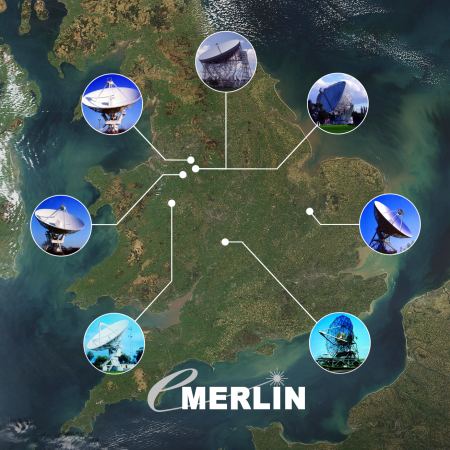
e-MERLIN is an array of seven radio telescopes, spanning 217km, connected by an optical fibre network to Jodrell Bank Observatory. The e-MERLIN National Facility is operated by the University of Manchester at Jodrell Bank Observatory on behalf of STFC. The decision by STFC is great news for Jodrell Bank, and the international science community that it serves.
Zooming in on colliding neutron stars with e-MERLIN and EVN
16th October 2017
EMBARGOED UNTIL MONDAY, OCTOBER 16, 2017 AT 10:00 AM US EDT / 3:00 PM BSTThe radio telescopes of the UK's National Radio Astronomy Facility, e-MERLIN, have been directed low in the southern sky in recent weeks. Their target the aftermath of a collision between two neutron stars 124 million light years away.
The collision between these two super-dense remnants of exploded stars produced ripples in space-time which were detected by the LIGO gravitational wave observatory. Remarkably, other telescopes working across the spectrum from radio to gamma-rays were also able to detect the collision and its aftermath - the first time any cosmic event has been seen in both gravitational waves and by its electromagnetic radiation.
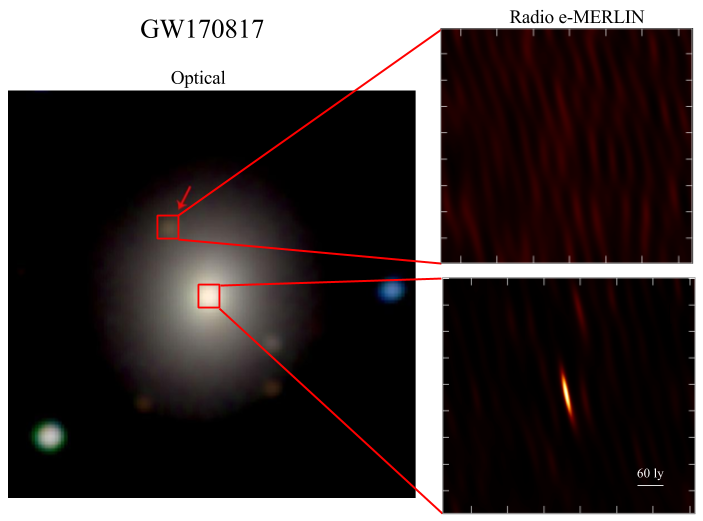
The power of e-MERLIN, working alone and in combination with the wider European VLBI Network of telescopes (EVN), is the ability to zoom in on the fine detail of these gravitational wave events and help pinpoint their precise locations. Observations with e-MERLIN began on August 23, just 6 days after the gravitational wave detection.
As Rob Beswick, Head of e-MERLIN Science Support at the University of Manchester's Jodrell Bank Centre for Astrophysics, explains, the observations of this particular event are challenging: "We are reporting today on 22 epochs of observation extending over the period from 6 to 36 days after the collision. This particular source is very low in the southern sky as seen from the UK, which means it only rises above the horizon for a few hours a day, limiting the time we can spend on it and hence making it harder to detect its very faint radio emissions.
"Even so, we are tantalisingly close to obtaining a detection. At the moment, our 1-sigma noise level is about the same as the faint transient signal detected by the Very Large Array 16 days after the outburst. Nevertheless, this places very useful stringent limits on the radio emissions over this period.
"We are continuing to obtain e-MERLIN and EVN observations. In the near future, we will also be able to include the giant Lovell Telescope in our array, greatly increasing its power. As the source evolves and potentially brightens in the coming weeks, this will make a detection far more likely."
Simon Garrington, Director of e-MERLIN and Associate Director of Jodrell Bank Centre for Astrophysics, added, "This discovery is hugely exciting and will be the first of many electromagnetic counterparts to gravitational wave sources in the coming years.
"e-MERLIN is a powerful instrument capable of providing rapid and extremely sensitive radio observations of these events with high magnification imaging that rivals that of the Hubble Space Telescope. The detection of radio emissions from these gravitational wave sources is right at the limit of our current capabilities; however planned enhancements to e-MERLIN over the next few years will make future follow-ups routine.
"e-MERLIN and EVN will be crucial tools to zoom in at radio wavelengths, enabling precise (millisecond) localisation of GW events in space. Detailed localisation is likely to prove fundamental to our understanding of the energetic processes at the heart of these titanic events."
Background
GW170817
Paper: GW170817: Observation of gravitational waves from a binary neutron star merger..
Paper : Multi-messenger Observations of a Binary Neutron Star Merger
Related press releases: JIVE
Neutron stars are the smallest, densest stars known to exist and are formed when massive stars explode in supernovae. As these two neutron stars spiralled together, they emitted gravitational waves that were detectable for about 100 seconds; when they collided, a flash of light in the form of gamma rays was emitted and seen on Earth about two seconds after the gravitational waves. In the days and weeks following the collision, other forms of light, or electromagnetic radiation - including X-ray, ultraviolet, optical, infrared, and radio waves - were detected.
The discovery was made using the U.S.-based Laser Interferometer Gravitational-Wave Observatory (LIGO); the Europe-based Virgo detector; and followed up by some 70 ground- and space-based observatories.
The initial detection of the gravitational signal, named GW170817, was first made on Aug. 17 at 8:41 a.m. Eastern Daylight Time; by the two identical LIGO detectors, located in Hanford, Washington, and Livingston, Louisiana. Virgo, situated near Pisa, Italy, also recovered a signal that allowed scientists to precisely triangulate the position of the source in a relatively small patch in the southern sky.
At nearly the same time that this detection was made the Gamma-ray Burst Monitor on NASA's Fermi space telescope had detected a burst of gamma rays. LIGO-Virgo analysis software put the two signals together and saw it was highly unlikely to be a chance coincidence, and another automated LIGO analysis indicated that there was a coincident gravitational wave signal in the other LIGO detector.
Rapid gravitational-wave detection by the LIGO-Virgo team, coupled with Fermi’s gamma-ray detection, enabled the launch of follow-up by telescopes around the world. In this follow up an optical transient was identified in the galaxy known as NGC 4993 - which is located over 130 million lights years away from Earth, and in the same region of the southern sky that the gravitational wave detection was made. While at the other end of the electromagnetic spectrum, the first detection of a faint, transient radio emission was reported from the same galaxy by the Jansky Very Large Array (VLA) on Sep. 2, 16 days after the initial detection of the gravitational signal.
The LIGO-Virgo results are published today in the journal Physical Review Letters; additional papers from the LIGO and Virgo collaborations and the astronomical community have been either submitted or accepted for publication in various journals.
e-MERLIN
e-MERLIN is the UK's National Radio Astronomy Facility and is operated by the University of Manchester on behalf of the UK's Science and Technology Facility (STFC). e-MERLIN is an array of seven radio telescopes across the UK, connected to a powerful central correlator at Jodrell Bank Observatory (JBO), The University of Manchester. It is operated as a dedicated radio interferometer producing high-resolution radio images. With a maximum baseline length of 220 km, e-MERLIN provides a unique capability for microJansky sensitivity radio imaging, spectroscopy, polarisation and astrometry. The e-MERLIN/VLBI National Facility provides the UK contribution to the European VLBI Network (EVN), which links telescopes across Europe and China for observations at milliarcsecond resolution.
European VLBI Network telescopes
The telescopes involved in the observation of the neutron stars were part of the EVN and included: Effelsberg Radio Telescope (Max-Planck Institute for Radio Astronomy, Germany), Hartebeesthoek Radio Astronomy Observatory (National Research Foundation, South Africa), Jodrell Bank Observatory (University of Manchester, UK), Medicina Radio Observatory (National Institute for Astrophysics, Italy), Onsala Space Observatory (Chalmers University of Technology, Sweden), Noto Radioastronomical Station (National Institute for Astrophysics, Italy), Toruń Centre for Astronomy (Nicolaus Copernicus University, Poland), Ventspils International Radio Astronomy Centre (Latvian Academy of Sciences, Latvia), Westerbork Synthesis Radio Telescope (ASTRON, the Netherlands), and Yebes Observatory (National Geographic Institute, Spain).
More about e-MERLIN, VLBI, the European VLBI Network and JIVE
e-MERLIN and VLBI are radio interferometers which use multiple large radio telescopes distributed over great distances to observe the same region of sky simultaneously. Data from each telescope is sent to a central "correlator" to produce images with higher resolution than the most powerful optical telescopes.
The e-MERLIN national facility (www.e-merlin.ac.uk) is an interferometric array of 7 large telescopes (including the 76-m Lovell Telescope) spanning the southern half of the UK which are remotely connected to a central facility at Jodrell Bank Observatory via a dedicated high speed fibre network. With a maximum baseline length of 220 km, e-MERLIN provides a unique capability for microJansky sensitivity radio imaging, spectroscopy, polarisation and astrometry at 0.01-0.15-arcsec resolution in broad frequency bands. The e-MERLIN/VLBI National Facility provides the UK contribution to the European VLBI Network. The e-MERLIN National facility is operated by the University of Manchester on behalf of the UK’s Science and Technology Facility Council (STFC; www.stfc.ac.uk)
The European VLBI Network (EVN; www.evlbi.org) is an interferometric array of radio telescopes spread throughout Europe, Asia, South Africa and the Americas that conducts unique, high-resolution, radio astronomical observations of cosmic radio sources. Established in 1980, the EVN has grown into the most sensitive VLBI array in the world, including over 20 individual telescopes, among them some of the world's largest and most sensitive radio telescopes. The EVN is administered by the European Consortium for VLBI, which includes a total of 15 institutes, including the Joint Institute for VLBI ERIC (JIVE).
The Joint Institute for VLBI ERIC (JIVE; www.jive.eu) has as its primary mission to operate and develop the EVN data processor, a powerful supercomputer that combines the signals from radio telescopes located across the planet. Founded in 1993, JIVE is since 2015 a European Research Infrastructure Consortium (ERIC) with six member countries: France, Latvia, the Netherlands, United Kingdom, Spain and Sweden; additional support is received from partner institutes in China, Germany, Italy and South Africa.
Shocking case of indigestion in supermassive black hole
4th July 2017
e-MERLIN as part of a multi-wavelength study of a pair of colliding galaxies has reveals the cause of a supermassive black hole's case of 'indigestion'. Results will be presented by Dr Hayden Rampadarath at the National Astronomy Meeting at the University of Hull.
Once every couple of hundred million years, the small galaxy NGC 5195 falls into the outer arms of its larger companion, NGC 5194, also known as the Whirlpool galaxy. Both galaxies are locked in a gravitational dance that will result - billions of years in the future - in the formation of a single galaxy.
As NGC 5195 plunges into the Whirlpool, matter streams onto the supermassive black hole at NGC 5195's centre and forms an accretion disc. The disc grows to a point where the supermassive black hole can no longer accrete or 'digest' efficiently and matter is blasted out into the surrounding interstellar medium. Last year, NASA's Chandra X-Ray observatory spotted arcs of X-ray emission that appeared to result from this 'force-feeding'.
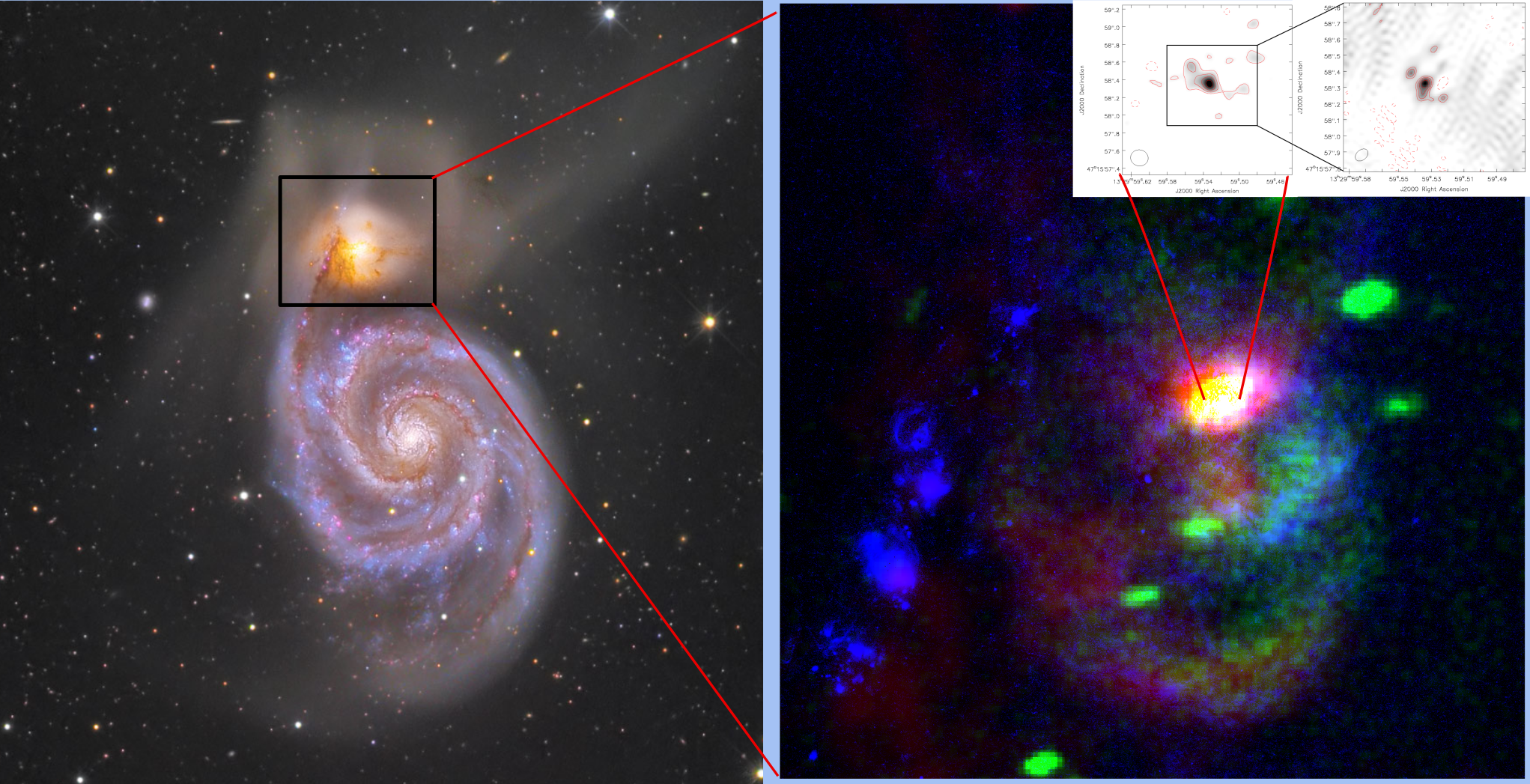
For full details of this announcement see RAS press release
Ghana and South Africa celebrate first success of African network of telescopes
4th July 2017
Ghana and South Africa have announced the first successful detection of fringes during a VLBI (Very Long Baseline Interferometry) test experiment with the European VLBI Network (EVN). A 32 metre converted telecommunications antenna at Kutunse, Ghana, was used in the 'first fringe' detection. The experiment is one of three positive detections, with the other two successes including methanol maser detection and pulsar observations. This is an exciting milestone in the development of the African VLBI Network (AVN), and indicates that the Kutunse antenna can be used as a radio telescope for single dish observations and as part of a VLBI network. The fringes were found by combining data from Kutunse and other participating EVN stations using the SFXC software correlator, designed by the Joint Institute for VLBI ERIC (JIVE). Confirmation of the success came with a joint announcement from the ministers of Ghana and South Africa.
Via both the Newton funded DARA (Development of Africa with Radio Astronomy) and the EU funded Jumping JIVE, University of Manchester and e-MERLIN national facility staff have provide support for the these developments through training opportunities in the development and use of VLBI in radio astronomy
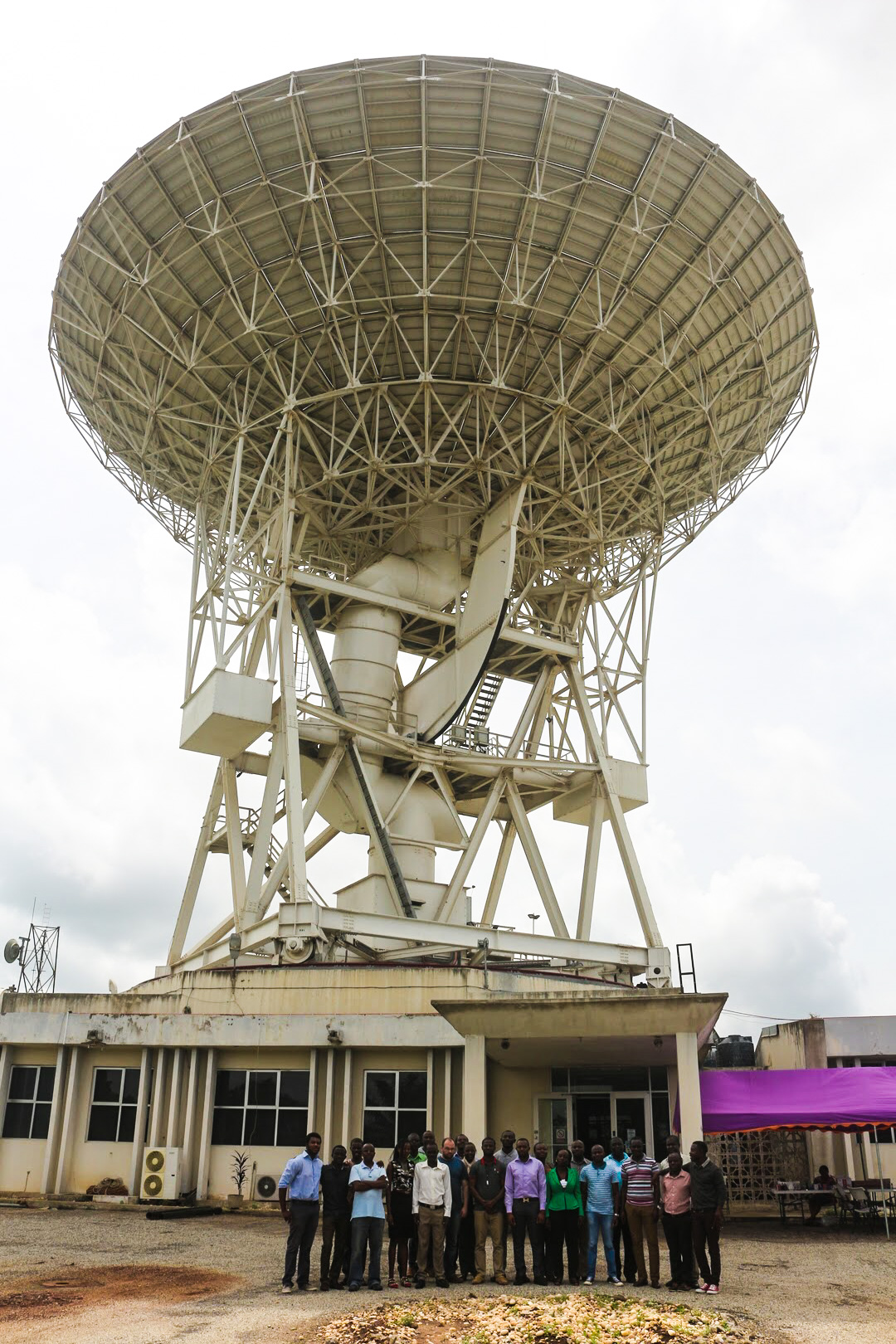
For full details of this announcement, and the work of JIVE, visit the JIVE website
JUMPING JIVE: a global leap for the European VLBI network
21st February 2017
JBCA and the e-MERLIN National Facility are one of twelve institutes participating in JUMPING JIVE (Joining up Users for Maximising the Profile, the Innovation and the Necessary Globalisation of JIVE), which has been awarded nearly 3 Million Euros by the EU's Horizon 2020 Programme over the next 4 years.
Today (21 February) marks the official start of the project with a kick-off meeting in Leiden, where all partners will discusss the implementation of the project.
For full details of this announcement, and the work of JIVE, visit the JIVE website
Cycle-5 e-MERLIN : CALL FOR PROPOSALS
15th Januray 2017
Deadline : Midnight (23:59 GMT) 16th March 2017
This is the 5th open round for e-MERLIN proposals, with observations scheduled for April/May 2017 onwards.
NEW: In Cycle-5 e-MERLIN will be offering new observing band capabilies at K-band (20-26GHz).
Please see Cycle-5 call for proposals and technical capabilities or email emerlin [at] jb.man.ac.uk if you have any questions about e-MERLIN Cycle 5 observing opportunities.
Meeting announcement:
e-MERLIN and Jodrell Bank Observatory:
A radio astronomy facility for the SKA era
Two Day workshop, Jodrell Bank Observatory 15-16th September 2016
The UK is taking a global leadership role in the SKA project. The HQ of the SKA Organization will be based in the UK at Jodrell Bank, and the UK is leading the international investment in the SKA.
e-MERLIN, the UK's National Radio Astronomy facility, and the 76-m Lovell Telescope constitute major radio astronomical facilities providing sub- arcsecond resolution imaging capabilities and state-of-the-art pulsar time- domain capabilities. Both are unique and world-class facilities and in combination have 25% of the collecting area of SKA1-mid with similar baseline and frequency coverage making them a powerful standalone instrument and pathfinder for SKA science.
We invite the UK's astronomical community to an open workshop discussing the latest science results from e-MERLIN and the Lovell telescopes and the development of a new integrated radio facility for the next era of Radio Astronomy.
e-MERLIN featured in Astronomy & Geophysics
June 2016

The June issue of the Fellow's magazine of the Royal Astronomical Society, Astronomy & Geophysics, had a special cover feature and four articles describing the development of, and early science results from, our very own network of radio telescopes, e-MERLIN. Operated by the University of Manchester from Jodrell Bank, e-MERLIN is the UK's national facility for high- resolution radio astronomy, and has users from around the world. The special series of articles, coordinated and edited by Megan Argo, includes contributions from twenty researchers spread over three continents, and covers everything from star-forming regions in the Milky Way to very high redshift gavitationally-lensed quasars, and everything in between.
The series starts with a description of the history of the original MERLIN array, describing the technological advances and improvements that made possible the upgrade to e-MERLIN (with a factor of 30 increase in sensitivity over the old system), written by Simon Garrington and Rob Beswick. Next in the series, PhD students Charlie Walker and Ben Shaw take a look at how e-MERLIN is being used to probe stellar evolution within the Milky Way, including a look at how we can use radio interferometry to investigate the processes of both star and planet formation. Moving out into the wider universe, Megan Argo rounds up a selection of results looking at other galaxies within the local universe, and what these studies can potentially tell us about more distant objects. The series concludes with an article by Tom Muxlow looking at how e-MERLIN is helping us probe the star formation rate history of the universe, and what gravitational lensing can help us probe important cosmological parameters.
Table of contents: http://astrogeo.oxfordjournals. org/content/57/3.toc
Cycle-4 e-MERLIN : CALL FOR PROPOSALS
10th May 2016
Deadline : Midnight (23:59 GMT) 26th May 2016
This is the 4th open round for e-MERLIN proposals, with observations scheduled for September 2016 onwards.
NEW: In Cycle-4 e-MERLIN will be offering new observing band capabilies at K-band (20-26GHz).
Please see Cycle-4 call for proposals and technical capabilities or email emerlin [at] jb.man.ac.uk if you have any questions about e-MERLIN Cycle 4 observing opportunities.
e-MERLIN Joins European VLBI Network
13th April 2016
In the latest call for proposals for observations using the European VLBI network (EVN) it was announced that it is possible to request that e-MERLIN outstation telescopes be included in the network. The EVN is an interferometric array of radio telescopes spread throughout Europe (and beyond, see image bot- tom left) that conducts high resolution radio astronomical observations of cosmic radio sources.
e-MERLIN is an array of seven radio telescopes operated by the University of Manchester based in the UK that consists of shorter baselines than VLBI and provides complementary resolution to allow larger scale structure of radio sources to be simultaneously investigated. This capability means that e-MERLIN occupies a unique posi- tion within the EVN.
The inclusion of the remote e-MERLIN antennas is now possible following recent software upgrades on the e- MERLIN correlator which can process the telescope sig- nals that are returned to the Observatory over the fibre network (at 30Gbit/s per telescope) into a form suitable for the EVN where the data rate is reduced to 1GBit/s total.
This means that EVN experiments can now include up to 4 of the e-MERLIN outstation telescopes in addition to either the Lovell or MK2 Telescopes at Jodrell Bank Ob- servatory, and the data can be delivered either live over the internet or sent later using hard disks.
Radio Astronomers see a black hole come to life
9th July 2015
42 million light years away, 20 million times the mass of the Sun, and coming back to life. A team of radio astronomers, led by Dr Megan Argo of the Jodrell Bank Centre for Astrophysics, are watching a previously dormant black hole wake up in a dramatic display as material falls on to it for the first time for perhaps millions of years. Dr Argo reported their work today (9 July) at the National Astronomy Meeting at Venue Cymru, in Llandudno, Wales. to read more
Astronomers See Pebbles Poised to Make Planets
6th July 2015
A team of astronomers led from St Andrews and Manchester universities today (6 July) announced the discovery of a ring of rocks circling a very young star. This is the first time these 'pebbles', thought to be a crucial link in building planets, have been detected. Dr Jane Greaves of the University of St Andrews presented the work at the National Astronomy Meeting at Venue Cymru in Llandudno, Wales. to read more
Spectacular supernova's mysteries reveal
22nd August 2014
New research by a team of UK and European-based astronomers is helping to solve the mystery of what caused a spectacular supernova in a galaxy 11 million light years away, seen earlier this year.
The supernova, a giant explosion of a star and the closest one to the Earth in decades, was discovered earlier this year by chance at the University of London Observatory. These phenomena are extremely important to study because they provide key information about our universe, including how it is expanding and how galaxies evolve. to read more
Cycle-2 e-MERLIN : CALL FOR PROPOSALS
Deadline : Midnight (23:59 GMT) 15th April 2014
This is the third open round for e-MERLIN proposals, with observations scheduled for September 2014 onwards.
Please see Cycle-2 call for proposals and technical capabilities or email emerlin [at] jb.man.ac.uk if you have any questions about e-MERLIN Cycle 2 observing opportunities.
Announcement of e-MERLIN data school and early science meeting
The e-MERLIN instrument is a high-resolution radio interferometer, capable of routine sub-arcsecond resolution imaging at centimetre wavelengths to sensitivity levels of a few microJy. Observations are competitively allocated by the Panel for the Allocation of Telescope Time, with a substantial proportion of time in the first few years being reserved for large Legacy Programmes. The science programme is wide-ranging and includes the study of the history of star-formation and black hole growth in galaxies, the physical processes which govern the formation of stars, the modes of activity in nearby galaxies, and the energetic processes in relativistic outflows from jets generated by black holes and compact objects.
e-MERLIN has now been in full operational mode for some months, and a meeting will be held in Manchester from 10-11 April 2014 to discuss early science, both from the Legacy projects and from PATT observations from Cycle 0 and the early part of the Cycle 1 allocations. Prior to that, on 20-21 January, there will be a two-day data school, the aim of which will be to help those unfamiliar with the techniques of radio interferometry to reduce e-MERLIN data, including the use of existing analysis pipelines provided by the observatory, in time to present results at the early science meeting.
Please see Meeting webpages for registration details and more information
Cycle-1 e-MERLIN : CALL FOR PROPOSALS
Deadline : Midnight (23:59 GMT) 17th June 2013
The second open round for e-MERLIN proposals is planned for 2013, with observations scheduled for September 2013 onwards.
Please see Cycle-1 call for proposals and technical capabilities or email emerlin [at] jb.man.ac.uk if you have any questions about e-MERLIN Cycle 1 observing opportunities.
Mysterious hot spots observed in a cool red supergiant
25th April 2013
Astronomers have released a new image of the outer atmosphere of Betelgeuse one of the nearest red supergiants to Earth revealing the detailed structure of the matter being thrown off the star.
The new image, taken by the e-MERLIN radio telescope array operated from the Jodrell Bank Observatory in Cheshire, also shows regions of surprisingly hot gas in the star?s outer atmosphere and a cooler arc of gas weighing almost as much as the Earth.
K-band status and upgrades:
April 2013
Work is progressing on upgrading the eMERLIN K band receivers by replacing the low noise amplifiers (LNAs) with a new MMIC design. Current tests indicate that the new LNAs will deliver a more uniform and significantly lower system temperature across the band from about 19.9 GHz to 26 GHz while providing the full 2GHz per polarization eMERLIN bandwidth.
Initial telescope tests are currently expected towards the end of summer 2013, with the full system expected to be deployed on all e-MERLIN telescopes and available for Cycle-2 observations.
e-MERLIN reveals the structure of a new 'superluminal transient' source in M82
November 2012
Recent observations using the newly available e-MERLIN telescope have revealed the resolved structure of 'superluminal transient' radio source in M82. Results from these new observations, which have been obtained for the LeMMINGs e-MERLIN legacy project have recently been presented at a large international conference in Bordeaux, France.
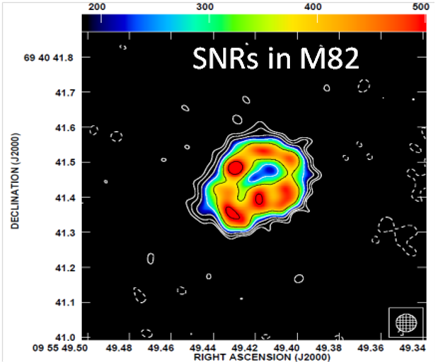 e-MERLIN C-band image of typical radio supernova remnant in M82. These observations were taken as part of the e-MERLIN
LeMMINGs legacy programme.
e-MERLIN C-band image of typical radio supernova remnant in M82. These observations were taken as part of the e-MERLIN
LeMMINGs legacy programme.
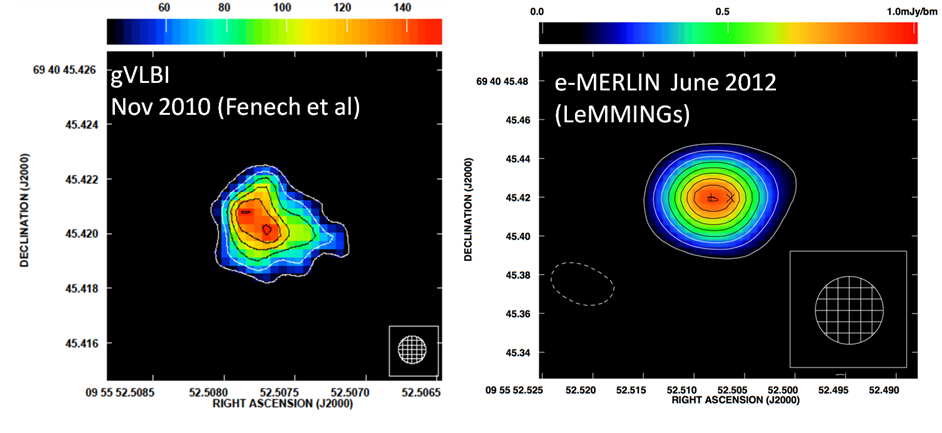
The left image shows a high resolution Global VLBI image at 5GHz of the transient source in M82. The right-hand image show the same source observed with e-MERLIN in 2012. Whilst at lower resolution the sensitivity and imaging quality of e-MERLIN allows this source to be resolved in an east-west direction confirming the earlier MERLIN proper motion estimates of its expansion and the VLBI imaging. These e-MERLIN (and VLBI) observations are part of ongoing research under the e-MERLIN legacy project, LeMMINGs.
The boiling face of Betelgeuse
November 2012
e-MERLIN has resolved fine details on the face of Betelgeuse. These are the highest-resolution images at cm wavelengths which show the full extent of the radiio photosphere, 25 AU (125 milli-arcsec) in radius, 6 times the optical photosphere. The sensitivity afforded by 500 MHz bandwidth, centred on 5.75 GHz (5.2 cm), reveals an additional arc to the SW. This probably represents enhanced mass loss, also seen in the IR by Kervella et al. (2009, 2011). The mass loss mechanism for a massive star like Betelgeuse just entering the red supergiant phase is rather mysterious, as there is not enough dust close to the star for radiation pressure on grains to drive a wind. The average brightness temperature of the radio photosphere at 5-6 GHz is about 1200 K, but e-MERLIN resolved two hotspots at 4000-5000 K. This is higher than the peak temperature of the optical photosphere (3600 K). The hot spots could be due to Betelgeuse's patchy chromosphere which is known to have a low filling factor (Harper et al. 2006), or to convection or pulsation shocks. Further work will identify which mechanism is responsible and the relationship with processes which could eject clumps of matter from the stellar surface to form the wind.
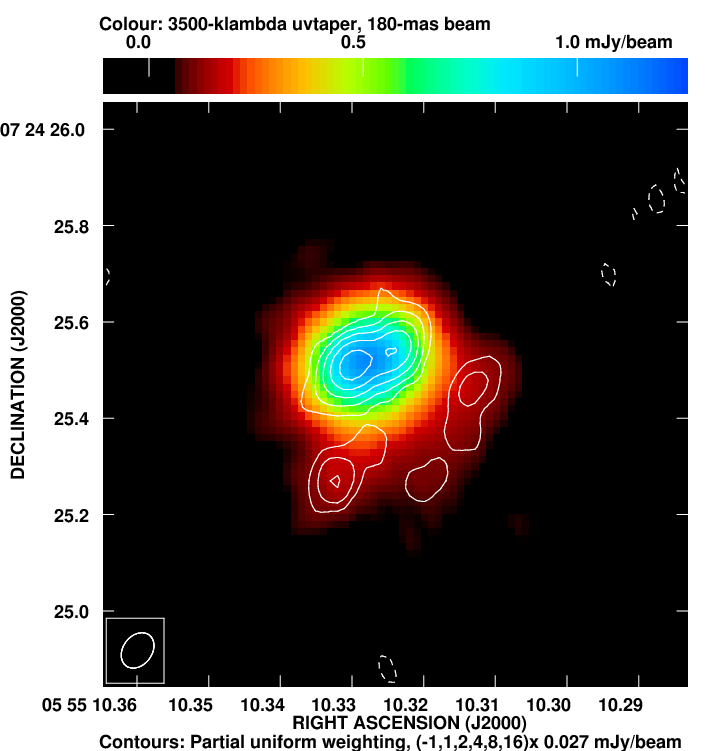
These results will be presented in a forthcoming publication and at the Betelgeuse Workshop 2012
The observations were made by
A. M. S. Richards, R.J. Davis, S.T. Garrington, I. McDonald (University of Manchester), S. Etoka (University of Manchester and Hamburger Sternwarte), L. Decin (Katholieke Universiteit Leuven), J. J. Lim (University of Hong Kong and Academia Sinica) and Markus Wittkowski (ESO).
e-MERLIN's deep radio survey of the Hubble Deep Field: First results
27 Mar 2012
27th March 2012: e-MERLIN's deep radio survey of the Hubble Deep Field: First results
A team of astronomers at Jodrell Bank Observatory have begun the deepest ever high-resolution radio imaging of the region around the Hubble Deep Field (HDF), the images originally captured by the Hubble Space Telescope (HST) in the mid 1990s. The HDF led to the discovery of numerous galaxies billions of light years distant and provided direct visual evidence of the evolution of the Universe. First results from the new imaging, which uses observations from the UK's newly upgraded e-MERLIN radio telescope array together with the EVLA radio array based in New Mexico, show galaxies some 7 billion light years away in unprecedented detail. Graduate student Nick Wrigley will present the new results at the National Astronomy Meeting in Manchester on 27 March 2012.
To read the full press release.e-MERLIN Cycle-0 online simulator tool
12 Jan 2012
12th January 2012: e-MERLIN call for proposals Cycle-0 (semester 2012A)
A new web-based simulator designed to assist in proposal preparation for e-MERLIN, cycle-0 and beyond is now available at http://www.e-merlin.ac.uk/observe/eMERLINost.html
This easy to use simulator tool allows sensitivities, uv-coverages and simulated images to be produced to aid with all forms of e-MERLIN proposals.
e-MERLIN Cycle-0 (semester 12A) proposal submission tool is open
10 Jan 2012
10th January 2012: e-MERLIN call for proposals Cycle-0 (semester 2012A)
e-MERLIN is now open to proposals from the international astronomical community on the basis of scientific merit alone. Proposals are competitively peer-reviewed under standard STFC rules by the PATT e-MERLIN Time allocation Committee
The e-MERLIN proposal submission tool Northstar is now open for proposal submissions for Cycle-0
Proposal deadline = Midnight (23:59GMT) 26th January 2012
5 Jan 2012
5th January 2012: A boost for European Radio Astronomy
A boost for European Radio Astronomy
The European astronomy collaboration RadioNet has been granted 9.5 million Euros by the European Commission to fund its latest program, RadioNet3, for the years 2012 to 2015. This not only continues the two preceding European projects, but also takes a leap forward to include ALMA, as well as a number of pathfinder pro grams for the SKA. Read the full press release at the MPIfR site.10 Jan 2012
10th January 2012: e-MERLIN call for proposals Cycle-0 (semester 2012A)
e-MERLIN announces first open call for proposals
12 Dec 2011
12th December 2011: e-MERLIN call for proposals Cycle-0 (semester 2012A)
e-MERLIN is now open to proposals from the international astronomical community on the basis of scientific merit alone. Proposals are competitively peer-reviewed under standard STFC rules by the PATT e-MERLIN Time allocation Committee. During the first 5 semesters of e-MERLIN operations ~50% of observing time has been allocated to 12 large legacy projects and most of the remaining time will be allocated via PATT to standard proposals solicited prior to each observing semester. e-MERLIN provides high resolution (40-150mas) and high sensitivity (~6-12 uJy in this cycle 0) imaging at cm wavelengths as well as polarimetry, spectroscopy and astrometry. Shared-risk 'Cycle-0' observations will start in February 2012, with some limitations in observing capabilities.
Black holes and warped space: New UK telescope shows off first images
9 Dec 2010
9th December 2010: Black holes and warped space: New UK telescope shows off first images
This dramatic image is the first to be produced by e-MERLIN, a powerful new array of radio telescopes linked across the UK.
Spearheaded by the University of Manchester's Jodrell Bank Observatory and funded by the Science and Technology Facilities Council, the e-MERLIN telescope will allow astronomers to address key questions relating to the origin and evolution of galaxies, stars and planets.
To demonstrate its capabilities, University of Manchester astronomers turned the new telescope array toward the "Double Quasar". This enigmatic object, first discovered by Jodrell Bank, is a famous example of Einstein's theory of gravity in action.
The new image shows how the light from a quasar billions of light years away is bent around a foreground galaxy by the curvature of space. This light has been travelling for 9 billion years before it reached the Earth. The quasar is a galaxy powered by a super-massive black hole, leading to the ejection of jets of matter moving at almost the speed of light - one of which can be seen arcing to the left in this new e-MERLIN image.
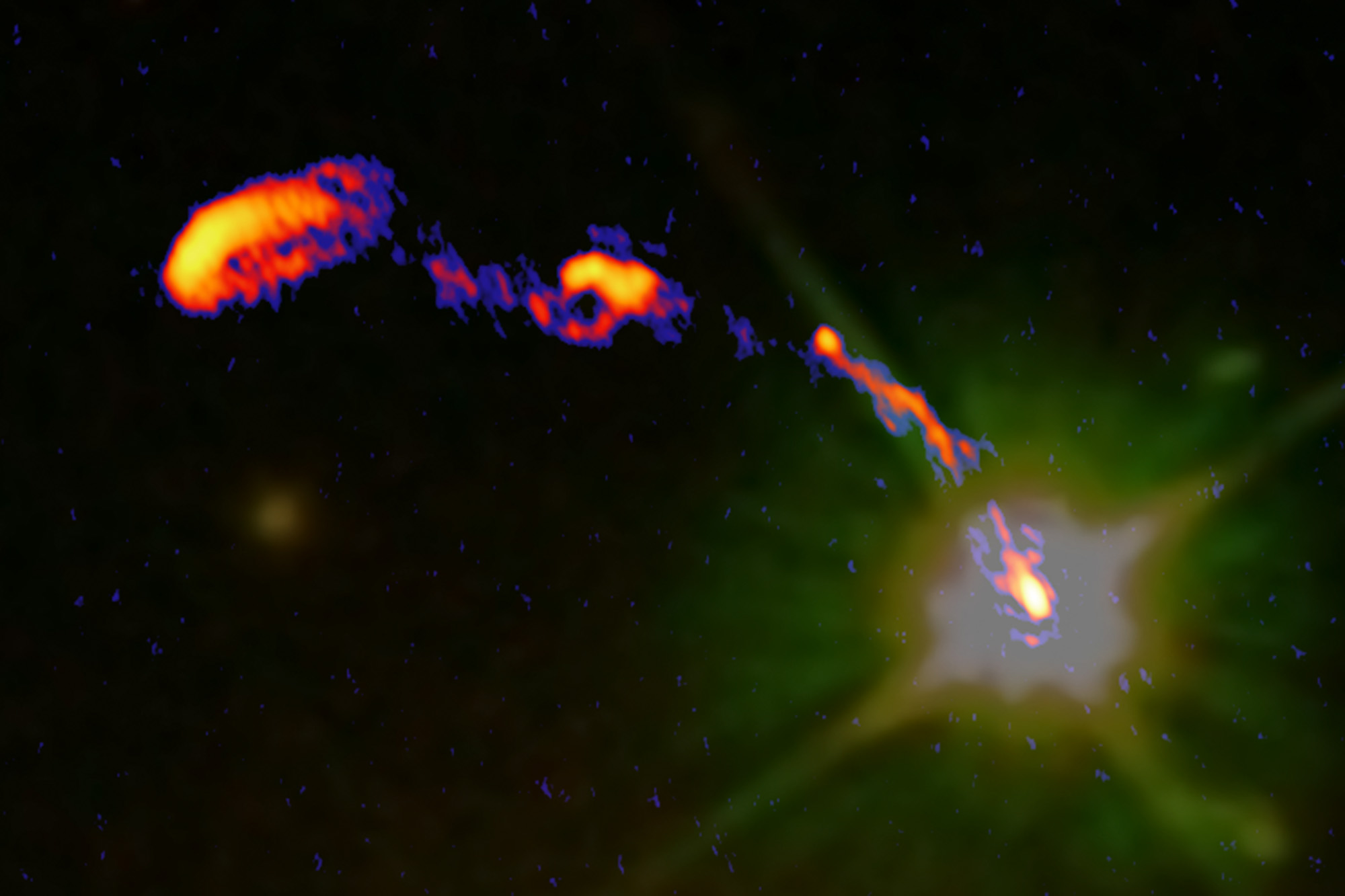
( ..more images available here..)
This is a composite of the new e-MERLIN radio image of the Double Quasar and an earlier Hubble Space Telescope (HST) optical image. One of the le nsed quasar core images is visible at lower right. The radio emission generated by the black hole as seen with e-MERLIN is visible as the compact bright region superimposed on the (yellow-green) optical emission seen by HST. The radio jet, moving at speeds approaching that of light, is see n in the e-MERLIN image arcing away from the black hole towards the upper left. The jet shows several regions of enhanced brightness before it en ds in a hotspot where it is ploughing through the tenuous matter filling the space around the quasar.The e-MERLIN image is shown in false-colour with a colour table ranging from blue through red to white, where the colours represent the bri ghtness of the radio emission. The HST image is made from WFPC2 images through two filters: the F555W filter (V-band) is coloured green and the F 814W filter (I-band) is coloured red.
Credit: Jodrell Bank Centre for Astrophysics, University of Manchester