Since UKRI announced its intention to withdraw operational funding for the e-MERLIN/VLBI National Radio Astronomy Facility at Jodrell Bank Observatory, discussions with STFC have continued. At the same time, Members of Parliament have written to ministers, and there has been significant media coverage and public interest. There have been leader articles in several major UK newspapers highlighting support for curiosity-driven science in general and for astronomy and Jodrell Bank/e-MERLIN in particular. We are heartened by the messages and support from across the research and cultural communities and the general public in the UK and around the world. The FAQ below provides further information on e-MERLIN, Jodrell Bank Observatory, and the consequences of decisions recently announced by UKRI and STFC.
A concise version of this FAQ has been posted by The University of Manchester and is available here.
A compilation of the e-MERLIN science highlights has been published online: e-MERLIN/VLBI science highlights.
What has been announced and what actions are being taken?
Updated: 12 August 2026
On 27 July 2026, STFC/UKRI announced that operational funding for the e-MERLIN/VLBI National Radio Astronomy Facility will not be renewed beyond the current contract, which ends on 31 March 2028. Without replacement funding, astronomical observations with all the Jodrell Bank telescopes supported by the national facility would cease from 1 April 2028. This includes all e-MERLIN observations, participation in European and Global VLBI Networks, and pulsar observations with the Lovell and other Jodrell Bank telescopes, whether as single dishes or as part of worldwide networks.
- The University of Manchester operates e-MERLIN on behalf of STFC for UK-based and international researchers, with access awarded on the basis of scientific merit.
- The affected funding supports e-MERLIN, the scientific operation of the Lovell Telescope, and the specialist scientific, engineering, software, technical and professional services teams required to run them.
- Other funding routes are being explored, but there is currently no confirmed alternative UK science funding stream.
What is the impact of the closure of e-MERLIN and the UKRI/STFC funding decision?
Updated: 12 August 2026
The impact is not simply the loss of one telescope programme. It would remove the UK’s operational national facility for high-resolution radio astronomy and its participation in European and global radio astronomy networks. Re-establishing these facilities would be difficult and costly. Jodrell Bank will have no scientific future as an active observatory.
- Closure of a globally unique capability: e-MERLIN provides high-resolution radio imaging that no existing or planned facility, including the Square Kilometre Array Observatory (SKAO), can replicate. e-MERLIN is used by thousands of scientists to address a wide range of fundamental questions in astrophysics and cosmology (as identified by UKRI).
- Major impact on the European VLBI Network (EVN): e-MERLIN and the Lovell Telescope provide a major and essential contributions to the EVN. Without them, the EVN would be much less capable, and the UK’s reputation as a trusted scientific partner could be jeopardised. Participation of the Lovell Telescope (the second-largest in the network) and the e-MERLIN antennas (which can account for up to half of the antennas in the network) has been entirely funded by STFC.
- Loss of skilled jobs and expertise: around 28 full-time-equivalent posts across astronomy, engineering, software, electronics, operations and technical support are at risk of being cut. These experienced teams, with highly specialised skills, are difficult to build and will be extremely hard to re-establish once lost. Additional posts are also at risk.
- Damage to national infrastructure: the loss would affect scientific discovery, technology development and the demonstrated capability to track and characterise satellites and space debris in high Earth orbit.
- Reducing the UK's ability to benefit from its over £ 300 million investment in SKAO: The UK hosts the SKAO's international headquarters at Jodrell Bank, a decision based on the presence of an active national radio astronomy facility. e-MERLIN trains future SKAO users, provides complementary high-resolution radio imaging, and helps sustain the scientific, technical and cultural environment around the SKAO Headquarters. Its loss would weaken the UK's leadership position in global radio astronomy.
What is e-MERLIN and why is it e-MERLIN important?
Updated: 24 August 2026
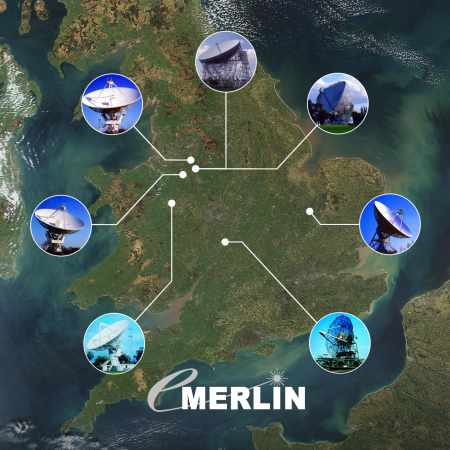
e-MERLIN is the UK’s national radio astronomy facility. It links seven large radio telescopes across the country by high-capacity optical fibre to create a telescope array with separations of up to 217km, operated from Jodrell Bank Observatory. It is a unique critical research infrastructure and national-scale capability.
- A unique capability delivering world-leading science: It delivers very high-resolution (sharp) radio imaging at centimetre wavelengths, probing physical processes that cannot be seen in visible light at scales comparable to those achieved by Hubble and James Webb Space Telescopes. It supports research on star and planet formation, galaxy evolution, black holes, pulsars, fast radio bursts, supernovae, gravitational-wave counterparts and other time-variable phenomena. A compilation of the e-MERLIN science highlights has been published online: e-MERLIN/VLBI science highlights. These scientific and technical capabilities are world-leading and not replicated by any other astronomical facility, currently available or under construction.
- An essential part of the international astronomy ecosystem: e-MERLIN and the Lovell Telescope act as a critical link between national radio telescopes, the European VLBI Network (EVN), and future SKA-VLBI operations. Around half of EVN observations currently make use of e-MERLIN, demonstrating its importance to international research programmes and partnerships.
- A world-leading facility operating today: SKAO is still under construction and not expected to reach full operational capability until the mid-2030s at the earliest. e-MERLIN is delivering high impact science now. It provides the UK's only operational high-resolution radio imaging capability and will remain scientifically important throughout the SKAO era and beyond.
- A key enabler of the UK's investment in SKAO: e-MERLIN provides the high-resolution complement to maximise the science return from the surveys which the Square Kilometre Array Observatory will carry out. It also trains many of the students and early-career researchers who will become future users and scientific leaders within the SKAO community, helping maximise the UK's return on its substantial investment in the project.
- Develop skills, innovation and future technologies: e-MERLIN trains the next generation of scientists, engineers, software developers and technical specialists, while also acting as a platform for instrumentation development, advanced computing and new technologies that benefit future scientific facilities.
- A significant capability for space situational awareness: The Lovell Telescope and e-MERLIN have recently demonstrated significant enhancements to the performance of space-surveillance radar systems, enabling the detection, tracking and imaging of satellites, space debris and near-Earth asteroids. These activities align directly with emerging UK priorities in space resilience, security and the protection of critical space-based infrastructure.
How have the national and international radio astronomy community responded?
Updated: 24 August 2026
Recognised leaders of the international radio astronomy community have written to say e-MERLIN, the Lovell Telescope and Jodrell Bank provide unique capabilities that complement the SKAO and are essential to UK scientific leadership. As letters continue to arrive we will add them to this FAQ.
Leading radio astronomy scientists from across the UK, Europe and beyond have published a series of open letters urging UKRI, STFC and the UK Government to reconsider the planned withdrawal of funding for e-MERLIN and related radio astronomy activities from April 2028. The letters come from recognised leaders of the international radio astronomy community, including Directors of major observatories, national research institutes, European research infrastructures and STFC-appointed expert committees. Together they represent organisations responsible for training the next generation of astronomers and engineers and delivering much of the world's high-resolution radio astronomy capability.
Although written independently, the letters deliver a common message: e-MERLIN, the Lovell Telescope and Jodrell Bank provide unique capabilities that the Square Kilometre Array Observatory (SKAO) will not replace in the next decade, at least. Therefore, e-MERLIN is essential to maintaining UK scientific leadership, skills and international partnerships.
The experts all stress that no existing or under construction facility replaces e-MERLIN's unique combination of sensitivity and angular resolution, noting that its images are at least five times sharper than those expected from SKA-MID. As described by Professor Melvin Hoare at the University of Leeds:
“The baseline design for SKA-MID included baselines out to 150 km for the very reasons mentioned above – the huge amount of cutting-edge science that can be accessed by having such spatial resolution. However, those baselines are not currently being built. The SKA-MID array as presently configured [maximum baseline 40km], will deliver angular resolutions comparable to those of the VLA rather than those of the e-MERLIN. Strategic decisions should therefore be based on the capabilities that will actually exist in the coming decade, rather than on aspirations whose implementation remains uncertain.”
RadioNet, the major consortium of European radio astronomy institutes say:
"We are also troubled that this decision comes at a time when other leading radio astronomy nations are increasing investment in national facilities alongside major international projects. Strong international leadership depends upon strong national capability. The UK's proposed withdrawal stands in stark contrast to this international trend and is difficult to reconcile with its role as host nation of the SKAO Headquarters.""
Members of the independent STFC-appointed e-MERLIN Steering Committee stress
"It is not credible that a country without a national radio astronomy programme can continue to be a key player in the SKA in the long term."
The European VLBI Network Directors write that
"We firmly believe that we need both the SKAO and strong national capabilities such as e-MERLIN and Jodrell Bank for the future of astronomy."
This sentiment is supported by the Instituto de Astrofisica de Andalucia (IAA-CSIC), one of Europe's leading astronomy institutes:
The strategic importance of e-MERLIN will increase, rather than diminish, in the SKA era.
This expert concern is also reflected by wider UK scientific bodies, public figures, many politicians and the general public. The Royal Astronomical Society has described the potential loss of Jodrell Bank capability as "devastating for UK astronomy", while the Institute of Physics has warned that the wider STFC funding decisions threaten the UK's scientific reputation, international collaborations and ability to attract future generations into physics.
Across all letters, a consistent request emerges: that UKRI, STFC, Government, The University of Manchester and international partners reconsider and work together to identify a sustainable solution that preserves e-MERLIN, the Lovell Telescope and the UK's leadership role in international radio astronomy.
List of received letters of support
- Members of the e-MERLIN Steering Committee Open Letter: STFC-appointed independent committee overseeing the e-MERLIN/VLBI National facility comprising leading academics and Industry members from the UK and beyond
- European VLBI Network Directors Open Letter: Directors of leading European radio observatories and institutes
- RadioNet Partner Organisations Open Letter: Major European radio astronomy institutes and research infrastructures
- Instituto de Astrofisica de Andalucia (IAA-CSIC), Spain Open Letter: Leading Spanish astrophysics institute
- Professor Melvin Hoare, University of Leeds Open Letter: SKA Science Working Group member and DARA Principal Investigator
- International Pulsar Timing Array (IPTA) Open Letter: International Collaboration of regional pulsar timing arraysAdded on 19th August 2026
How is e-MERLIN funded?
Updated: 12 August 2026
e-MERLIN operations are funded through STFC support, with the University of Manchester supplementing Jodrell Bank operations. The funding covers telescope operations, engineering, maintenance, software, scientific support, data processing and the specialist staff required to run a national facility.
Through e-MERLIN, STFC provides a financial contribution to the Lovell Telescope operation as part of UK and European networks. This contribution was significantly higher in the past (2018-2023), and STFC used to make additional significant contributions to support the Lovell Telescope for key observational programmes (pulsars and cosmology). As a result of these decreasing contributions from STFC, the University of Manchester has provided its own support for the Lovell Telescope, mostly for mechanical and operational activities, so that research could continue. These staff also contribute to e-MERLIN operations. In practice, JBO is an integrated team of engineers, technicians and scientists, the majority of whom are funded by STFC. The complete withdrawal of STFC funding will completely decimate this team, whose many decades of combined experience and expertise cannot easily be replaced.
Who owns and operates the Lovell and e-MERLIN telescopes?
Updated: 12 August 2026
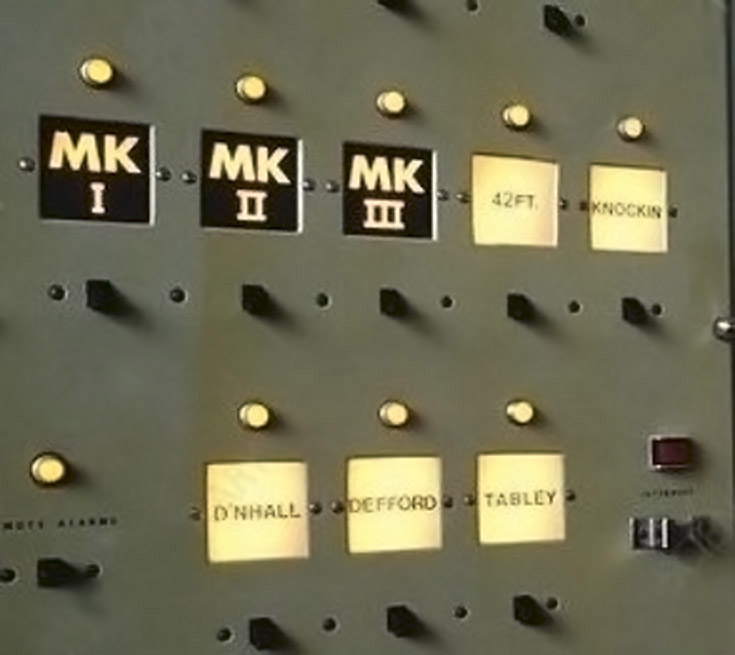
All the Jodrell Bank telescopes, including the Lovell Telescope and and e-MERLIN telescopes, located at Darnhall, Pickmere (in Cheshire), Knockin (Shropshire), Defford (Worcestershire), and near Cambridge, are fully owned, operated and maintained by The University of Manchester. e-MERLIN as a facility is operated by The University of Manchester on behalf of STFC for the UK and international scientific community. This includes participation of all the telescopes, including Lovell, in international VLBI networks.
The facility works closely with major international partners including the European VLBI Network, JIVE, LOFAR and SKAO, but these collaborations do not replace the need for UK operational funding. Without the funding for e-MERLIN, operations of the UK’s National Radio Astronomy Facility, e-MERLIN/VLBI and the Lovell telescope will cease at the end of the funding period.
Through e-MERLIN, STFC provides a financial contribution to the Lovell Telescope operation as part of UK and European networks. This contribution was significantly higher in the past (2018-2023), and STFC previously made additional significant contributions to support the Lovell Telescope for key observational programmes (pulsars and cosmology). As a result of these decreasing contributions from STFC, the University of Manchester has provided its own support for the Lovell Telescope, mostly for mechanical and operational activities, in order that research could continue. These staff also contribute to e-MERLIN operations. In practice, JBO is an integrated team of engineers, technicians and scientists, the majority of whom are funded by STFC. The complete withdrawal of STFC funding will completely decimate this team, whose many decades of combined experience and expertise cannot easily be replaced.
Who are the different entities on the Jodrell Bank site?
Updated: 12 August 2026
The Jodrell Bank site is home to three distinct organisations and activities: Jodrell Bank Observatory (JBO), the Jodrell Bank Centre for Engagement (JBCE), and the Square Kilometre Array Observatory (SKAO) Headquarters. While they share the same site and work together, they are separate entities with different roles, governance arrangements and funding models.
Jodrell Bank Observatory (JBO)
Jodrell Bank Observatory is an active scientific observatory and forms part of the Jodrell Bank Centre for Astrophysics at The University of Manchester (the majority of which is located in the Alan Turing Building on the central University of Manchester campus). JBO operates e-MERLIN and the Lovell Telescope, providing the scientific, engineering, technical and operational expertise required to support world-leading radio astronomy research. e-MERLIN has been fully funded by STFC and is used by thousands of researchers from across the UK and internationally. e-MERLIN and the Jodrell Bank telescopes participate in major international collaborations for very long baseline interferometry (VLBI), including the European VLBI Network (EVN) and the Joint Institute for VLBI-European Research Infrastructure Consortium (JIVE). This operational scientific capability is directly affected by the withdrawal of STFC funding for the e-MERLIN National Facility.Jodrell Bank Centre for Engagement (JBCE)
Engaging visitors, responding to their unlimited curiosity about the Universe, and inspiring future generations of scientists and engineers has always been a key part of our role at Jodrell Bank. Over the years, we have welcomed almost 6 million visitors from far and wide, and we currently attract 125,000 paying visitors each year, 25,000 of whom are school pupils on educational trips. This public interface to the Observatory’s work is managed by the Jodrell Bank Centre for Engagement, one of the University of Manchester’s Cultural Institutions.There is great value to the public of being able to visit an operating astronomical research observatory – funded by their taxes, but actually accessible to them within the borders of the UK. The opportunity to watch the telescopes move from one astronomical source to another, collecting radio waves from the distant universe, is hugely inspiring for our visitors. This is a unique opportunity provided by radio astronomy and Jodrell Bank. A very recent Royal Society report emphasises that opportunities to visit places such as Jodrell Bank are key to enhancing scientific literacy. Of course, there are also wider benefits. As a tourist attraction, the economic impact of our visitor facility for 2024-2025 was estimated at £4.7m by independent consultants. Since science centres are not part of the National Museums and Galleries scheme, entry must be charged for. Hence, the Centre operates largely as a social enterprise funded by ticket income, with some core funding from the University. The cut to STFC funding for e-MERLIN does not directly affect the funding of the visitor facilities, but it would remove the unique aspect, very much welcomed by visitors, of being able to see the telescopes in action at a world-leading research facility.
Square Kilometre Array Observatory (SKAO) Headquarters
Jodrell Bank is home to the offices of the international headquarters of the SKAO. The decision host the SKAO Headquarters in the UK and at Jodrell Bank was based on the site's long-standing international reputation in radio astronomy and the strength of e-MERLIN and Jodrell Bank Observatory’s ongoing scientific contributions. The SKAO is an independent intergovernmental organisation established by international treaty and is separate from The University of Manchester, Jodrell Bank Observatory and the Jodrell Bank Centre for Engagement.In summary, the funding announcement concerns the operation of Jodrell Bank Observatory's radio astronomy facilities, particularly e-MERLIN and the Lovell Telescope. It does not directly affect the Jodrell Bank Centre for Engagement or the operation of the SKAO Headquarters.
Why investing in SKAO is not the same as investing in Jodrell Bank Observatory
Updated: 12 August 2026
Investment in the Square Kilometre Array Observatory (SKAO) is not the same as funding e-MERLIN or Jodrell Bank Observatory.
The SKAO, which has its headquarters office at Jodrell Bank, is a separate international organisation established by treaty and is independent of both The University of Manchester and e-MERLIN. The SKAO is responsible for developing and operating the SKA telescopes in Australia and South Africa, and does not own or operate the Lovell Telescope or the e-MERLIN network.
While the SKAO and e-MERLIN will work together when operational, they provide different but important capabilities for international astronomy and funding for one does not fund the other. At Jodrell Bank and e-MERLIN, we greatly value our continued collaboration with SKAO. Without alternative e-MERLIN funding the opportunities for UK-based radio telescopes, including e-MERLIN and Jodrell Bank facilities, working in tandem with SKAO as part of a global array extending the scientific reach and discovery potential of both facilities will be lost.
Why has the announcement attracted media attention?
Updated: 24 August 2026
The announcement has attracted significant national, regional, and international coverage because Jodrell Bank is both a world-renowned scientific observatory and a major cultural symbol of UK science. Much of the reporting has focused on the risk that active scientific operations could end, even if Jodrell Bank continues as a visitor attraction (JBCE) and the host of the SKAO headquarters.
A selection of the articles published since the funding announcement was made can be found below:
- The Guardian: Artists, writers and scientists urge UK government to save Jodrell Bank Observatory
- BBC News: What is Jodrell Bank Observatory and what does it do?
- Royal Astronomical Society statement: Mass cuts and potential Jodrell closure devastating for astronomy
- Associated Press: The future of the UK’s renowned Lovell radio telescope is in question after a funding cut
- The Observer: Earth to Whitehall: the wonder and knowledge of Jodrell Bank is beyond all price
- The Telegraph: Jodrell Bank faces closure in act of ‘scientific vandalism’
- The Financial Times: Time for Andy Burnham to smile on UK science
- The Times: Jodrell Bank funding cut ‘threatens Britain’s space defences’
- Sky News: UK's largest telescope could be shut down after funding cut
- The Register: Signals are grim for Jodrell Bank Observatory after UK science funding decision
- Research Professional News: Jodrell Bank funding cut does real damage to UK science
- Nature News: Scientists up in arms about cuts to UK physics and astronomy
Have e-MERLIN’s capabilities and technology been superseded? Is e-MERLIN ‘old’ technology?
Updated: 12 August 2026
No. e-MERLIN is unique and at the forefront of international astronomy research. e-MERLIN and the Lovell Telescope have been continually upgraded with state-of-the-art technology. e-MERLIN is fully complementary to planned facilities such as SKAO and is integral to international networks such as EVN. e-MERLIN provides scientific capabilities that are not available or replicated elsewhere in the world. It is the only radio telescope in the world capable of producing images with resolutions matching the Hubble or James Webb Space Telescopes at centimetre wavelengths all year round.
- e-MERLIN already provides images which are 5x sharper than those which SKAO will deliver in 5+ years time. This is because e-MERLIN antennas as spread over 220km compared to the 35km extent of SKA-mid in South Africa. SKAO does not replace e-MERLIN. They are different and complementary instruments. SKA is designed for surveys of millions of objects at low resolution, e-MERLIN is designed to provide detailed images of objects.
- e-MERLIN is currently undergoing a major digital upgrade which is funded by STFC, including the replacement of all of its electronics using similar technology to SKAO which will further advance the capabilities of e-MERLIN and provide a platform for innovation for the next decade.
Is e-MERLIN cost-effective?
Updated: 12 August 2026
Yes. e-MERLIN's annual operating cost funded by STFC is £2.8 million, with an additional University contribution of around £1 million to overall Observatory operations, supporting telescope operations, engineering, maintenance, software and specialist staff across a national facility. Since 2008, the facility has introduced significant efficiencies, reducing its operating costs by more than 40% in real terms.
- Modest operating cost, unique capability. The e-MERLIN operating costs are a tiny fraction of the operating costs associated with major international observatories. The cost of e-MERLIN operations is approximately 2% of the expected operating cost of SKAO. It has innovated to deliver cost-effectiveness, delivering savings to STFC, and its current operational costs are more than 40% lower in real terms than in 2008.
- High scientific output per UK pound invested. The facility supports a substantial stream of peer-reviewed scientific publications and postgraduate research outputs. On a cost-per-research-paper basis, e-MERLIN is better value than most large international facilities.
Who uses e-MERLIN?
Updated: 17 August 2026
e-MERLIN is an international facility used by thousands of researchers in the UK and around the world, not a local observatory reserved for Manchester. e-MERLIN use is extremely competitive: projects are selected by an independent panel and demand outstrips availability by a factor of more than 3.
- e-MERLIN has thousands of registered users
- Around 40% of users are based in the UK, with a further 24% based elsewhere in Europe.
- Many of our users are early career researchers (ECRs), defined as those pursuing a PhD or within 6 years of obtaining one. e-MERLIN plays an important role in training the next generation of researchers. Early-career researchers lead and contribute to the majority of e-MERLIN projects.
- e-MERLIN routinely provides up to 50% of the individual telescopes operating as part of the EVN.
Is a sovereign capability in radio astronomy important?
Updated: 12 August 2026
Yes. A sovereign UK capability in radio astronomy matters because it gives the UK operational expertise, immediate access to infrastructure, influence in international partnerships and a training base for future facilities.
- Scientific access and reciprocity: countries that operate high-quality national facilities are stronger partners in the international open-skies radio astronomy ecosystem.
- Skills and training: operating live infrastructure in the UK trains engineers, technicians, software specialists, observers and operators in ways that cannot be replaced by overseas subscription alone.
- Space Situational Awareness: Jodrell Bank and e-MERLIN have demonstrated applications in detecting, tracking and characterising satellites and space debris. This would not be possible within the framework of international facility.
- Public inspiration: Jodrell Bank’s active scientific role is fundamental to its value as a place where the public can see frontier research happening in the UK.
If stopped, could the e-MERLIN and JBO infrastructure be restarted later?
Updated: 12 August 2026
In practice, restarting would be extremely difficult. Once specialist staff disperse, equipment is decommissioned, and operational expertise is lost, rebuilding capability can take many years and require substantial new investment.
e-MERLIN relies on a highly specialised workforce, unique infrastructure, and international partnerships that have been built over decades. The array connects seven major radio telescopes across the UK through a dedicated high-capacity fibre network, creating a capability that cannot be easily replicated. If operations cease, much of this expertise would be lost, international collaborations would disperse, and equipment, software, and facilities would deteriorate without ongoing maintenance and upgrades.
Rebuilding the facility later would require substantial new investment, new recruitment of specialist staff, restoration of the network and observatory systems, and substantial re-commissioning work before scientific operations could resume.
In short, while a restart is theoretically possible, closure would likely result in the loss of a unique UK research platform and capabilities that have taken decades to develop. It is far easier and more cost-effective to sustain e-MERLIN than to rebuild it after closure.
What is RASOR?
Updated: 12 August 2026
RASOR, the Radio Astronomy and Space Observation Research proposal, is a proposed UK-wide facility. It would build on existing UK expertise and facilities such as e-MERLIN, LOFAR and Jodrell Bank Observatory to support frontier science, space safety, space weather monitoring and national resilience.
A white paper describing RASOR has been submitted to the Department for Business, Innovation, Science and Trade.
RASOR is not a like-for-like replacement for current e-MERLIN operations. It is a future-facing proposal that shows how the UK could expand from today’s infrastructure into a stronger sovereign capability. Preserving e-MERLIN and Jodrell Bank operations keeps that pathway open.
RASOR is as a proposed dual-use UK-wide facility designed to address strategic needs for sovereign UK capability in three key areas:
- Space Situational Awareness (SSA): active and passive real-time radio detection, tracking, characterisation and imaging of potential threats to key UK assets in GEO orbit;
- Dedicated observing facilities to provide resilient and distributed space weather and geodetic monitoring to feed UK prediction of adverse space weather events and support sovereign Position, Navigation and Timing (PNT) initiatives, protecting both space assets and critical national ground-based infrastructures; and
- High-resolution and rapid-response radio astronomy imaging to enable UK scientists to investigate and understand the flood of new phenomena coming from next-generation optical and radio sky survey instruments.
The RASOR concept builds on world-leading UK expertise and major investment in national and international radio astronomy and space weather projects. It will add 10 new state-of-the-art radio telescopes and 4 further LOFAR stations to the one at RAL, Chilbolton. These will add to the existing e-MERLIN array capabilities and build upon e-MERLIN’s existing high-speed digital infrastructure. The antennas would be placed across the entire United Kingdom, co-located at sites that will maximise engagement and grow skills, whilst capitalising on the UK’s involvement and investment in SKAO to leverage cost-effective design and production.
RASOR will create a network with a maximum extent of approximately 800km, more than 20x the extent, and hence resolution, of SKA, and similar to the best resolution that next-generation optical telescopes such as ELT will generate. RASOR locations will be chosen to optimise space weather monitoring and prediction for the UK. The wide separation plus the incorporation of some larger super-sensitive antennas will complement and potentially work with the compact configuration proposed for the DARC radar facility. RASOR will also establish a UK geodetic network for precise measurements of Earth orientation and rotation, essential for Position, Navigation & Timing (PNT).